Posts

Preparations

Image
I'm writing these posts in order to help make the reading a little easier for Jay—but also as a way to think more purposefully about the novel myself. This is my fourth time (in 12 years) reading this book, and I want to pause for a moment and think about why I'm inclined to keep coming back to this book. My only regret with regard to   Middlemarch   is that I did not read it in my early 20s, so that I could now be reflecting on how the book feels at very different stages of life. Other writers have addressed this, and I'm envious of them. (I'm happy that Jay is still young enough that she will, I hope, have this experience over the next 40-60 years of her life.) On this topic, I'm reminded of Rebecca Mead, who felt what I've been trying to describe so acutely that she wrote a book about it:  My Life in Middlemarch . I haven't read it yet, but I think I'll do so after this. Here she is describing herself at 17: " I loved  Middlemarch , and I loved b...

Map of Middlemarch

Image
  Ch. 7 The image below is from a series of illustrations made for Rebecca Mead's memoir, My Life in Middlemarch (2014).  Lowick: Casaubon Tipton Grange: Mr. Brooke (Celia and Dorothea at the start of the novel) Freshitt Hall: Sir James Chettham Stone Court: Peter Featherstone Middlemarch: the actual town (where there are a few businesses, etc.)

Book I, Chapters 1 - 5

Image
Ch. 1 So, today's thought (as I begin re-reading myself): Take your time with the first chapter, particularly with anything Eliot is telling you about Dorothea (introduced as "Miss Brooke"; she'll be referred to this way in other places too). Celia isn't all that important in the novel, but she's important here as a contrast to Dorothea. Also, it might be a bit subtle, but there IS some humor in this opening chapter, particularly the way Celia pokes at Dorothea and kind of undermines her older sister's high-mindedness. Celia sees that D. has grand ideas and convictions but that she's also a little lacking in self-awareness. Finally, Dorothea is "religious" in a sense, but maybe not in the conventional way we think of that. It's more that she has this over-riding sense of piousness / goodness / correct behavior. And particularly the notion of self-abasement in a quasi-religious sense. She thinks she should suffer / deny herself worldly ple...

Book I, Chapters 6 - 12 (end of Book I)

Image
Ch. 6 (less important) This chapter marks the introduction of Mrs. Cadwallader, the plain-spoken, cheap, and gossiping wife of the local rector. She has some great lines, though the parts of this chapter that deal with politics are difficult to follow—and not particularly important to the development of the novel as a whole. The most interesting part of this chapter is where Mrs. C talks with Celia and Mr. Brooke about Dorothea's engagement to Casaubon, and her sharing of this news with Chettam shortly thereafter, along with her immediate efforts to point Chettam toward Celia as a romantic prospect.  Ch. 7 This strikes me as a particularly important chapter. It explores how three different characters (Dorothea, Casaubon, and Mr. Brooke) are situated in relation to questions of how women ought to acquire or use various types of knowledge. Dorothea does not want knowledge (of Greek or Latin langauges) simply in order to serve Casaubon's scholarly needs: "she wished, poor chi...

Book II: Old and Young

Image
  Ch. 13  Here we are primarily concerned with the banker, Nicholas Bulstrode. He first meets with the new doctor, Lydgate, and it's slightly significant that neither is native to Middlemarch. We don't yet know much about the origin of either, but we will later. Lydgate wants to know that Bulstrode will continue to fund the new hospital wing, but Bulstrode's interest is almost entirely the result of his spiritual rather than medical convictions. The key point of disagreement here is that Bulstrode wants to ensure that his preferred clergyman be given the role of chaplain in the new hospital. That man is Tyke, who is more traditional/conservative than Farebrother, whom we'll get to know later. Lydgate doesn't care about this side of things—he's driven by science—but he recognizes that it could jeopardize progress/funding if he opposes Bulstrode, who is obsessed with "sacred accountableness." Note that whenever Bulstrode (or Eliot, describing him) uses t...

Book III: Waiting for Death

Image
Ch. 23  We come to know Fred Vincy much better in this chapter, following along as he attempts to make some money in horse-trading. We also learn more about Caleb Garth (Mary's father, and, some critics have suggested, a man modeled on Eliot's own father). You can move quickly through this chapter, focusing your attention mainly on Fred's ability to delude himself (at which he is expert). Ch. 24 I find this chapter painful to re-read. The plot turn (Fred facing the Garths with his unfortunate news) is clear enough, but I'm more interested in the character portraits of Caleb and (wife) Susan Garth. Eliot holds them both in high regard, it seems, though she does let Caleb have his flaws. Interestingly, his most significant flaw appears to be his generosity, feckless though it may be. Jay, when you finish this chapter, I wonder what you might predict for the future relationship between Fred and the Garths. And, more specifically, how do you think Fred's next visit with...

Book IV: Three Love Problems

Image
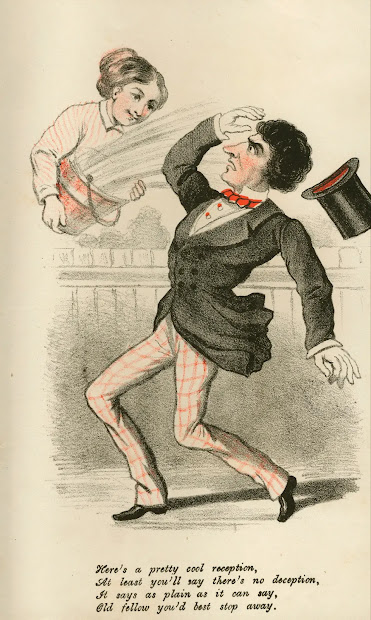
How convenient! Valentine's Day is just a few days away, so in honor of Book IV—Three Love Problems—I share with you some pictures of a genre I didn't know existed until 10 minutes ago: "vinegar" Valentines. Chapters 34 – 35  Funeral and reading of will all in the same morning—how efficient! I find it interesting that in the first pagaraph, Eliot effectively says: Featherstone was not a good man. But of course she knows what will emerge when the wills (plural) are read. For a moment, it seems that Fred Vincy will inherit £10,000 (the equivalent, one source tells me, of $1.7 million today), but a later will alters most of the inheritances so that money will be left to build poorhouses for old men. Except for the manor and land that will go to the "frog-faced" stranger, Joshua Rigg—who will now become Joshua Featherstone. One other detail in Ch. 34 is of note: Will Ladislaw is near (staying at Tipton Grange with Mr. Brooke), and Dorothea is aware of the disple...