Book V: The Dead Hand
Chapter 43
With these posts, I'd like to do a little more than just summary—I'd like to analyze some of the details that give the novel its richness. But I'm increasingly finding that what I want to address leads me to giving away plot points.In any case, here we get our first glimpse into the domestic life of Lydgate and Rosamond—but first the awkward and unplanned meeting of Will and Dorothea at the Lydgates'. Eliot allows to see how both Dorothea and Will "process" this encounter, and I'm struck by the apparent difficulty Dorothea has in seeing why it might be untoward for a married woman to play host to an unmarried man alone (apart from her husband). Dorothea really is this innocent with regard to the realities of male-female attraction, it seems. In her defense, she senses that something might be objectionable, but she can't quite identify it with any specificity. But this scene does push her closer to gaining some first-hand understanding of the dynamics at play.
Will, on the other hand, is "mortified," but not because he's been caught in some vaguely inappropriate moment with Rosamond; no, it's because Dorothea "had seen him under circumstances in which he might appear not to be supremely occupied with her [Dorothea]" (408). He is smitten. But also a bit delusional, it would seem. I'm surprised at how plainly he states his adoration of Dorothea to Rosamond, calling her a "perfect woman" and more or less agreeing with Rosamond's assessment that he is a "devout worshipper" (409).
Finally, we learn more about Rosamond's inner workings, particularly her new understanding that even when married she can "make conquests and enslave men." She doesn't mean, of course, to have an affair (in our sense of the word), but to be the master of men in a variety of settings. She'll start with her husband, but she's already learning through Will that she can have other playthings for her mastery.
One last observation: Lydgate seems to be talking about Will when he describes the danger of becoming attached to certain women, but he shifts his language slightly so that the danger becomes more generalized: "He only neglects his work and runs up bills" (410). File this thought away for now....
Chapter 44
Dorothea meets with Lydgate at the hospital and he persuades her to contribute money to that cause. Dorothea again strikes me as guileless and utterly innocent (in the sense of being unversed in the realities of the world), and Casaubon is unenthusiastic about her intentions—but not inclined to dissuade her. One interesting line here from Casaubon's perspective: "If he ever felt keenly any question of money it was through the medium of another passion than the love of any material property" (414). I wonder if Eliot is hinting at something related to Will, particularly in that wording of "another passion." We shall see.Chapter 45 (less important, except the end)
Here Eliot digs in to the medical controversies in Middlemarch, and has some fun revealing the foolishness of the folk remedies that have had so much sway over the people. Early in the chapter, it's clear that the concept of an autopsy is a source of great fear in common people, with Mrs. Dollop opining (not direct quote, but close enough) that a decent doctor would "know what was the matter with you before you died, and not want to pry into your inside after you were gone" (415). This reveals a basic mistrust of the scientific process. Understandable at some level, of course, but foreign to us today.I find one interesting parallel to modern medicine in the fact that conventional doctors at the time seemed to make most of their money by dispensing drugs. Big pharma! Lydgate doesn't take this approach, which earns him distrust and dislike from his medical colleagues—and skepticism from plenty of patients. Opinion remains divided about him, but numerous patients have done well thanks to his care.
At the end of the chapter, Lydgate and Rosamond discuss his passion for medicine, and it's clear she doesn't care for it. She wishes he did something else. It's subtle, but we detect that Lydgate is disappointed by this limitation in his wife. In his mind, he's doing important work, and he sees now that it is of no consequence to Rosamond; she just wants the status that's attached to his profession (while wishing it were something higher / less . . . gross).
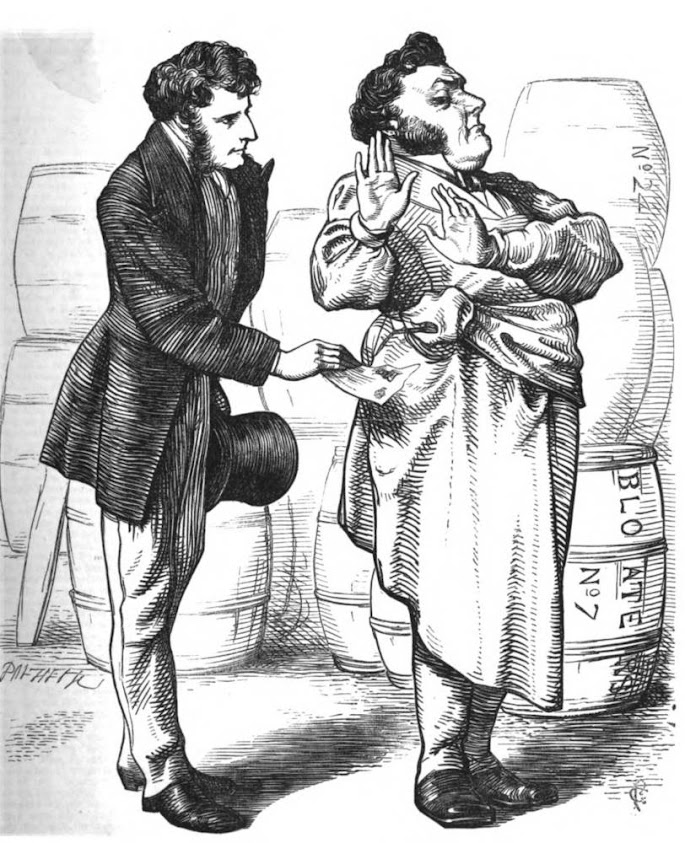
Electoral Purity
Indignant Voter to Political Agent: — “Offer Me Five Pounds for my vote! I blush for you sir! I never sold my vote, never in all my life, Sir — for less than three times that amount!”
Source: Hathi Digital Library Trust web version of a copy in the Princeton University library.
Chapter 46 (less important; mostly about Reform)
About Reform, as simply as I can put it (which is too simply, but good enough for a blog, I hope): The goal of reform was two-fold. First, it sought to get rid of "pocket boroughs," which were small areas where one or two landholders would have outsize power in Parliament and at the same time create new MPs (Members of Parliament) from cities that had grown significantly (Manchester, Birmingham, etc.) since the advent of the Industrial Revolution. These cities had no representation, so it's easy to see why Reform seemed necessary to many. Second, Reform sought to extend the vote to "middle-class" men. It would still be limited to men, but it would include small landowners, tenant farmers, and shopkeepers. It was an important first step toward broader voting rights (still decades away).We see Will in two settings here—first in mild dispute with Mr. Brooke about Reform; Will is frustrated because Mr. Brooke, as in so many things, attempts not to commit himself. In the second part of the chapter, Will again finds himself in dispute, this time with Lydgate. It's hard to follow every aspect of their disagreement, but it's not difficult to see where they end up: defending their own choices of the men who are their benefactors (Mr. Brooke for Will; the banker Bulstrode for Lydgate).
At the end of the chapter, we learn that Lydgate is concerned about unpaid debts—and that Rosamond wants to get pregnant.
Chapter 47
Eliot at her best again. As I read this chapter, I identify deeply with Will—he's so convinced that his actions are reasonable, and he's exceedingly skilled at arranging the facts in a way that suits his own desires. I hope you'll forgive the personal connection here, but I recognize Will's thinking so clearly, and I wonder how it is that I still fall into the same traps. Maybe we all do, despite time and experience and the vague recognition that we should know better. My favorite characterization of this mental self-manipulation: "Having silenced Objection by force of unreason, Will walked to Lowick . . . " (442).I'm sure it's my own limitation because clearly Eliot wants me to reject the impulse, but I have to say that I am aligned with Will when Eliot characterizes his thoughts about Casaubon thus: "But most of us are apt to settle within ourselves that the man who blocks our way is odious, and not to mind causing him a little of the disgust which his personality excites in ourselves" (442-3).
At the end of the scene, Will recognizes that he seems to be the cause of some "agitation" in Dorothea, and now he is filled with regret at having gone to the Lowick church.
Chapter 48 . . . take your time with this one
This chapter needs little in the way of explanation, but it's one that we'll likely want to return to when thinking about the arc of Dorothea's character. Eliot allows us to see (and feel) Dorothea's growing doubt in her husband's work—and, more importantly, her doubt about the commitment she has made to it. Again I notice a pattern in the imagery Eliot uses in this connection: "She longed for work which would be directly beneficent like the sunshine and the rain, and now it appeared that she was to live more and more in a virtual tomb, where there was the apparatus of a ghastly labor producing what would never see the light" (446).To call it "light" and "dark" is too simplistic, of course, though it does begin there. I'm interested in the contrast between the forces of nature and those of the tomb. Even Tantripp (Dorothea's servant) detects it in a couple of different ways, telling her mistress once that she should avoid that "close library" (451). Close in this sense literally means "without fresh air," though it also suggests oppressiveness and enclosure: tomb-like, in other words. Tantripp later tells the butler she wishes that "every book in that library was built into a caticomb for your master" (452).
And now, a lengthy personal digression: I've never been a scholar in the accepted meaning of the word; I've read scholarly works, done a bit of writing that attempted to exist in that realm, edited some scholarly writing, etc. And while I've found real value in some scholarly works, I've always felt conflicted about the genre as a whole. A relevant (I hope) aside: My favorite short story is Tobias Wolff's "Bullet in the Brain," and part of what I love about that story is its implicit critique of literary criticism; in the story, the protagonist is an embittered book critic, probably about 60 years old (the 1985 equivalent of Casaubon's late 40s), who is such a condescending and sarcastic ass during a bank robbery (he critiques the bank robber's cliched speech) that one of the robbers shoots him dead. Before he dies, though, Wolff takes us inside his head for a brief journey through some of what Anders (the critic) does not remember:

Yes, Naomi and Kim, I hear you objecting! Yes, in order to appreciate many great works (like, duh, Middlemarch!) you need to know—or at least will benefit from knowing—all kinds of things that lie outside the work itself. But in my experience, too much literary criticism is an insider's game that rarely helps knowledgeable and curious readers experience a great novel in a meaningful way.
Rant over, for now at least.
Wait, one more thought: This is why I changed my major from English (where I took a number of upper-division courses and got tired of having great literature ruined) to philosophy—because at least the philosophers are honest about how arcane and convoluted their work can be. And they only abuse each other—not great works of literature/art.
Back to the book. Casaubon makes an outrageous and indefensible request of Dorothea, and while she suffers in contemplation of whether to agree to it, this most apropos line appears, so I'll end with it: "Books were of no use. Thinking was of no use" (446).
[Note: I value books and thinking very, very much.]
Chapter 49
At the risk of spelling out what is probably clear to even a first-time reader, I want to be precise about what Sir James Chettam and Mr. Brooke are discussing. Specifically, Casaubon made a codicil to his will saying that if Dorothea married Will Ladislaw, she would be disinherited. I know I didn't fully take this in the first time I read the book because I simply didn't believe Casaubon was capable of such cruelty. I thought I must have misunderstood it because it wasn't possible that he would have specified such a prohibition in his will. But he did, and it will be more clear in the chapters to come.As I re-read the end of Chapter 48, I see that Dorothea herself had some presentiment about exactly this possibility: "Might he not mean to demand something more from her than she had been able to imagine. . . ?" (451). In these moments, Dorothea is consumed by how dreadful it would be to feel compelled to take up Casaubon's pointless work after his death, but for an instant she is able to contemplate that he might have some additional and more personal demand. But she dismisses the thought, concluding, "No; his heart was bound up in his work only" (451).
Well, we know from the conversation between Sir James and Mr. Brooke that this was not the case.
I have to say that while I agree with Mr. Brooke that Will cannot be simply sent away in order to protect Dorothea, I find Sir James's analysis of the situation compelling and sensible. And I return to my earlier belief that he would have made an excellent match for Dorothea—he adores her and wants to protect her, and his instincts about Casaubon have always been accurate. I think he's right to show some annoyance, particularly when he reasserts his long-held position that Mr. Brooke failed Dorothea in not attempting to dissuade her from marrying Casaubon: "Well, I can only say that I think Dorothea was sacrificed once, because her friends were too careless" (457). And finally, Sir James is the only one (it seems) to see that Will's intentions/desires may not beentirely gentlemanly: "But I suspect Ladislaw. I tell you frankly, I suspect Ladislaw" (457).
Chapter 50
How are Dorothea and Celia blood related? How is it possible? I frequently want to shake some common sense into Dorothea, but Celia with "baby" is insufferable. I do appreciate, though, that she takes on the unpleasant task of informing her sister about the codicil to Casaubon's will. Then again, the task probably isn't all that unpleasant to her since she makes no secret of her repulsion toward Dorothea's dead husband: "We should not grieve, should we, baby?" (461).Most significantly in this scene is Dorothea's first conscious recognition of her possible feelings for Will; shifting away from her own feelings of "repulsion" from the not-so-dearly departed, Dorothea becomes "tremulous" and experiences a "sudden strange yearning of heart towards Will Ladislaw" (461).
Dorothea is taken to Lowick to go through Casaubon's things; she seems to hope to find some expression of love or tenderness toward herself buried in a desk drawer. But none are to be found. I love this parenthetical inclusion from Eliot, who is again funnier than I remember: "(Not that Mr. Casaubon called the future volumes a tomb; he called them the Key to All Mythologies)" (463). Something about this plainness of statement just cracks me up—am I wrong to think that Eliot is mocking him here?
Finally, Lydgate recommends that Dorothea consider naming Farebrother to Casaubon's vacated post as reverend of Lowick. I'm not sure why/how Dorothea would have that power—wouldn't it belong to a regional bishop? Someone clarify, if you care to. In any case, Lydgate is doing a good turn for Farebrother, who seems here to be a thoroughly good man. Maybe not so chaste as others (he does like to gamble, but at least he's good at it), but interesting and reliable.
Chapter 51 . . . focus on Will here
You'll find plenty of information about the election process that you can move through quickly. The most important parts of the chapter come at the beginning and the end, when Eliot allows us to hear how Will is thinking about his standing in the town and his prospects with Dorothea. ("Prospects" isn't quite the right word, but it's close enough.)I remember finding the scene with Mr. Brooke making his speech a bit confusing on the first time I read it. I feel slightly more confident now: Someone has made a life-like "effigy" (just a piece of cloth with a resemblance of Brooke painted on it) of Brooke and is waving it around while he speaks. And someone (Bowyer?) repeats some of Brooke's lines in order to mock him. It doesn't help, of course, that Brooke is a little drunk of sherry—and that he doesn't have the sharpest and most disciplined mind to begin with. In short, his speech is a shambles. In the moments after, Brooke tells Will he's giving up his political ambitions, and with them, his desire to use the Pioneer as a tool for political influence. Will suspects that he's being pushed away from Middlemarch, but he's decisive—he won't go.
Chapter 52
I find this chapter quite bittersweet. We see the happiness in the Farebrother household early on as we learn that Camden Farebrother has received the position of rector at Lowick, thanks to Dorothea (and Lydgate). This will mean a significant jump in salary, so there are good feelings all around. We also hear it proposed from his sister that Farebrother might like Mary Garth as a wife. Farebrother doesn't correct his sister, and the remainder of the chapter is taken up with his meetings with Fred Vincy and Mary Garth. Farebrother makes a good case for Fred to Mary, in spite of the fact that he clearly has his own feelings for Mary. One of his most honorable turns is when he explains that her refusal to burn Mr. Featherstone's will did not cause Fred to lose out on the £10,000. Farebrother wants to make this point clear, fearing that Mary might agree to marry Fred out of a sense of guilt that he didn't get the Featherstone windfall.Most importantly, Farebrother makes a strong case for Fred—and pushes Mary to be clear about her intentions. She has a moment of recognition in which she sees that Farebrother himself might be in love with her, and she takes the opportunity to admit that she is only capable of feelings for Fred. By the end of the scene, she is in tears, feeling that "something indefinable, something like the resolute suppression of a pain in Mr. Farebrother's manner, made her feel suddenly miserable" (487).
Chapter 53 . . . the plot thickens
I don't believe I've mentioned this before, but now seems like a good time. This novel was originally two separate plot lines in Eliot's mind—one primarily focused on Dorothea, another on the various events in a small, provincial town during the lead-up to Reform. In this chapter, we find ourselves firmly in the second plot-line, and for me the book suddenly feels more like a mystery than a "marriage plot." The strands of this mystery begin to reveal themselves with the return of Raffles, the man we encountered some time back—the stepfather of Joshua Rigg, the man who inherited Stone Court from Peter Featherstone.As if that wasn't complicated enough, we now have Raffles tormenting the new owner of Stone Court, Nicholas Bulstrode. Remember that Bulstrode has been a successful (and powerful) banker in Middlemarch—but also remember that he is as much known for his religiousness as for this financial acumen. He couches much of his speech—both to others and in his internal monologues—in terms of the benefit of any action as being rooted in a desire to do what would be seen as most pious.
In this chapter, it becomes clear that, at least in part, this tendency in him is rooted in some past shame. We don't know exactly what it is, but we do get two significant hints. The first comes when Raffles says that he "might have done better by telling the old woman that I'd found her daughter and her grandchild" (496). This will be clarified more precisely later, but for now we can conclude that Bulstrode somehow profited by the "old woman" not learning the whereabouts of her descendants.
The second clue is more obvious: Raffles speaks of a "Sarah," who must have been the daughter of the old woman. A few paragraphs later, Raffles recalls her last name: Ladislaw. And now we have a proper mystery, it seems. What is Will Ladislaw's connection to the information Raffles has shared? We'll find out.
Helluva cliffhanger for the end of Book V.


Fred and Rosamond are spoiled brats. I could throttle them both. This time around I have really appreciate all the historical (to Eliot) aspects of the novel: the coming of the railroad, the Reform Act, the beginning of serious medical science, the petty politics and their decidedly NOT petty possible effects on the "lower" classes. Even the whole notion of how to run your little kingdoms--Caleb and Dorothea (and Sir James, under D's spell) understand that caring for the buildings and land your tenants farm is all to the public good. Mr. Brooke's speech on the balcony had me in stitches. I just love him--he's a loveable ditherer who truly loves his nieces and took his guardianship seriously. He is also an idiot.
ReplyDelete